
Taekwondo surprised me in the best way, somehow blowing open the doors to my heart and quickly settling in to stay. In all honesty, I had expected Taekwondo to be a hobby that was discovered and discarded within a few months, just like so many others, yet it has easily become a major part of my identity.
I began Taekwondo in eighth grade – newly teenage and wanting to learn all the cool kicks I saw online. Well, if you didn’t know, they don’t start people at the cool kicks and sequences (gee, I wonder why), they start with basic stances and punches and kicks. The first thing I learned was a horse stance, because in warmups, you sit in horse stance to throw punches. And even though that wasn’t the coolest thing in the world, I was determined to figure it out. The tiny details matter to me – where exactly my hand has to end on a middle punch, the set of my shoulders, the direction my torso faces (fun note for all the math nerds out there: my first thought of how to write this was “the exact direction of the vector normal to my chest”). It was a puzzle and, well, if you’re reading these in order, you know I love puzzles.
So I stuck with it. Horse stance turned to front stance and back stance and sparring stance and, most recently, walking stance. Middle punch turned to high punch turned to low block and the many, many upper body blocks and strikes. And I learned my first kick! A front kick. But that front kick turned into roundhouse kicks and side kicks and hook kicks and back kicks, and before I knew it, I was the person I saw online (not actually though, I usually don’t take videos of myself practicing).
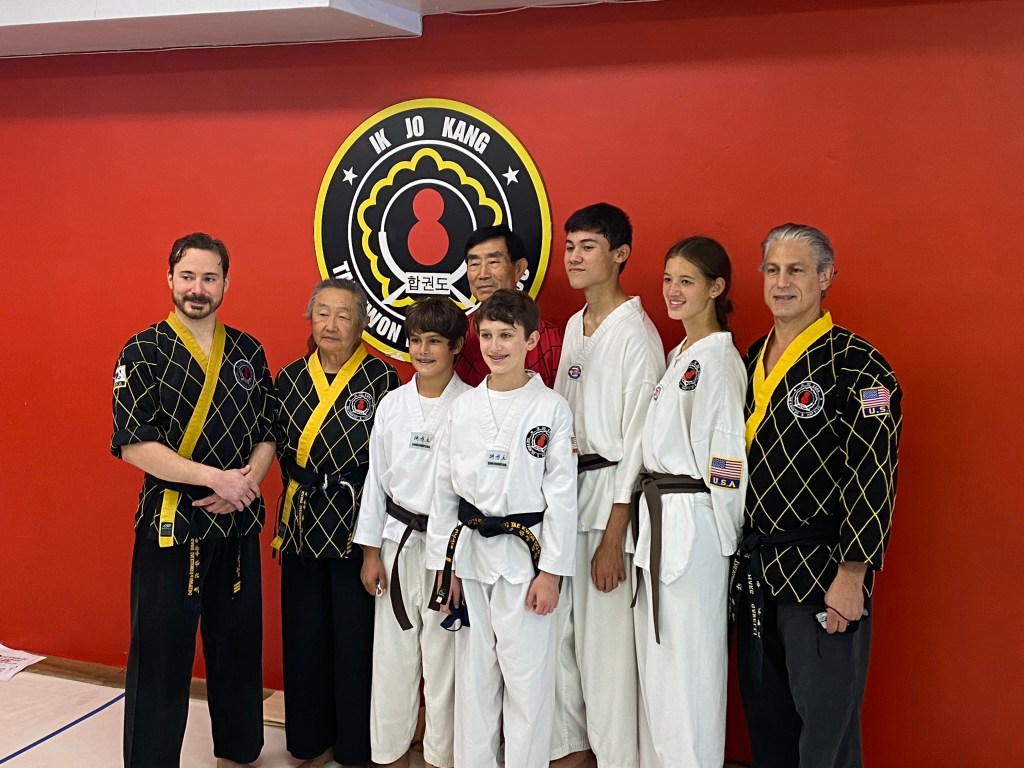
I earned my black belt in 11th grade, three and a half years after I first stepped on the dojang’s mat. Three and a half years of learning forms and movements, of learning to center my soul in my body, of learning to trust my teachers, my peers, and, eventually, myself.
I was, and still am, so incredibly proud of my black belt.
But a black belt isn’t the end of Taekwondo, just like graduating high school isn’t the end of learning. Anyone who says otherwise, to either of those statements, is simply incorrect.
For some people, getting a black belt is achieving their overarching goal, and therefore their road as a Taekwondo practitioner comes to an end. It’s an easy goal to set initially, and then the idea that a black belt is the crowning achievement is reinforced my society outside the martial arts world. No one will say “You’re a second degree black belt” with any more awe than they’d say “You’re a black belt.” After a black belt test is when you can separate the people who did it for the belt and the people who do it for the love of the sport.
Funnily enough, I had to take a break after my black belt test. I loved training, but there was a bit of a ‘too much, too fast’ feeling for me. I had gone from 0 to 100 very quickly, and I hadn’t let up at all. And, to be honest, there was still some of that “black belt is the top” mentality stuck in my head. I had to take a step back and ask myself if I had done it for the belt or if I had done it because I loved it. It was a mix of both, for me, but in the end I realized that even if part of me was going because I wanted a black belt, I still looked forward to, enjoyed, and was happy after every training I went to (what a different experience than the end of my soccer days…).
And now I’m here. I’m in university, training around 15 hours a week with my club team and helping the club as an Assistant Instructor. I earned my second degree through a grueling five hour test this past May. I’ve met amazing people and made incredible friends through the club, relationships that I know will last past graduation. So far, taekwondo has been a defining factor of my college experience.
And to think, it’s all because 13 year-old Sydney wanted to learn some cool kicks.
 Sydney L. Merrill