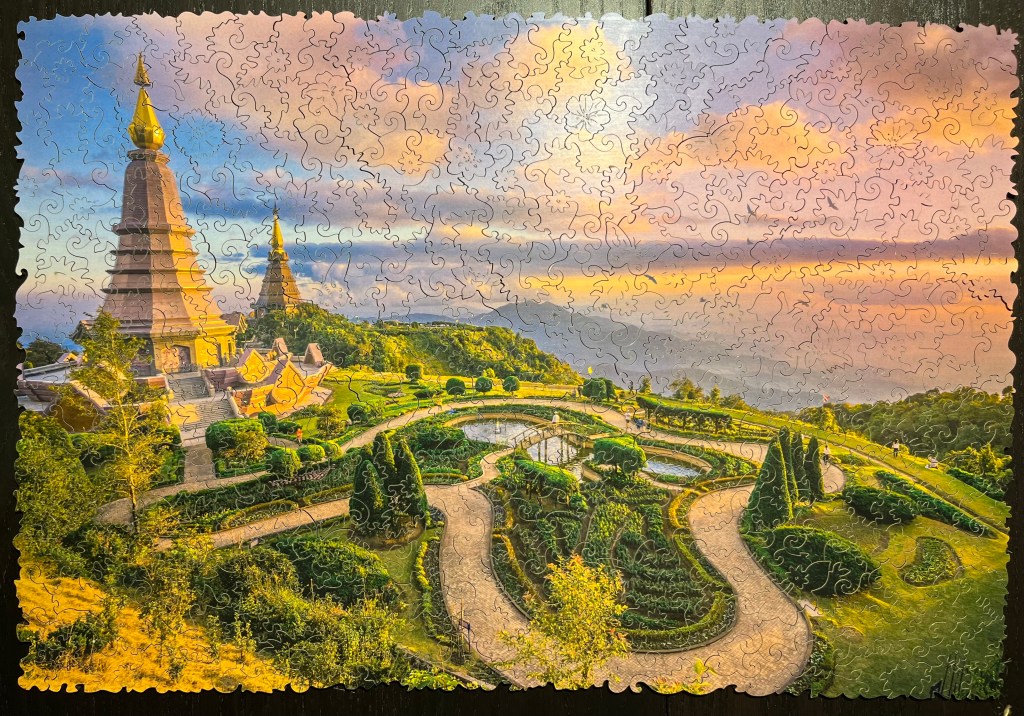
At first, the word “puzzles” only made me think of jigsaw puzzles, the ones you do on your kitchen table and lament at taking apart to clear up space. Those were the kinds of puzzles I’d been doing ever since I was old enough to put two pieces together.
I’ve developed a somewhat odd way of doing jigsaw puzzles, at least, that’s what my friends tell me. It starts normally, finding the corners and edges and putting that together. From there, some people will look for similar colors or parts of the same object or pieces that are close to the edge.
I simply pick up a piece and put it where it goes.
That makes it seem way more impressive than it actually is – I’m not some kind of psychic, nor do I have a photographic memory. I am, however, good at picking out little details from a piece and matching them to the image on the box. It’s a bit slow at the beginning, but the longer I spend on a puzzle, the more familiar I get with the image, and therefore the faster it is to identify pieces’ places.
There’s also something to be said about learning to choose pieces with distinctive features. If the piece depicts a feature that’s repeated in the exact or almost exact same way in multiple places of the puzzle, that’s probably a piece better left for later. A good place to start is usually living things, as they’ll almost definitely be distinctive.
Honestly, I’m kind of surprised that I haven’t met anyone who does puzzles the same way. I know this method only works for certain types of brains, but still. I’ve converted some of my family to this type of puzzling though, so I’ll count that as a win.
Of course, this only applies to jigsaw puzzles. I also love logic puzzles and escape games, which, while not being puzzles in and of themselves, contain lots and lots of puzzles. I think the first type of logic puzzle I ever played, like many, was sudoku. Eventually, I found samurai sudoku, a variation where there are five 9×9 grids, one in the middle and one connected to each of the four corners. Most of them are pretty hard, and I usually don’t finish them, but they’re really fun – I definitely recommend them if you’re looking to stick to sudoku but are getting bored with normal grids.
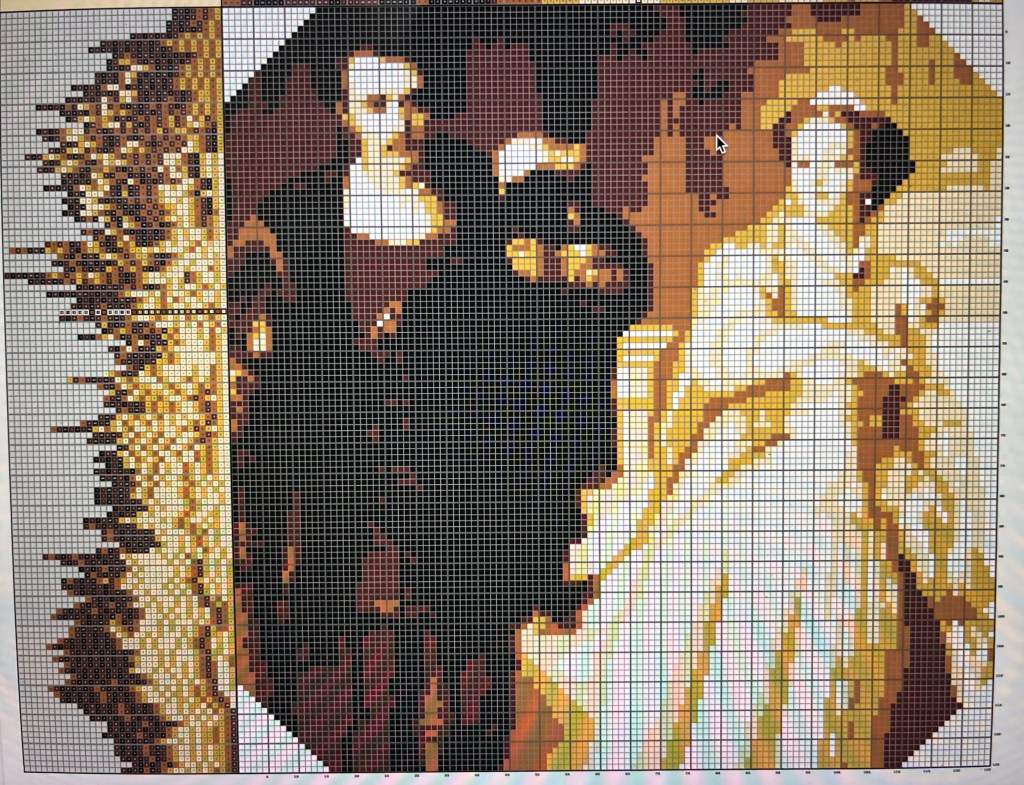
One of my favorite types of logic puzzles is nonograms, a number based grid puzzle that ends with a picture. Classically, nonograms are only in black and white – a square is either filled in or empty, but I enjoy nonograms that make use of colors. My crowning achievement thus far in nonograms is completing a 125×125 grid, which is the picture at the top of this post. It took me about 7 hours to finish, and the amount of times I had to recount the squares I colored in was honestly heinous. I was immensely proud when I was done, but I was also so ready to go back to my usual 45×45 grids.
The puzzle evenly matched with nonograms for the top spot in my heart is the logic grid puzzle, a variation of which (the same thing but without the grid) is found quite often in escape rooms. These are great because I don’t have to be on a device to do them – I have a book where each page is a new puzzle. This is super helpful for long plane rides and waiting for doctors’ appointments. Fun fact: my supplementary video for my college application was about logic grid puzzles. I think I completed five puzzles just for that video, but that was just me being picky. Anyways, it worked, I got into college, so obviously logic grid puzzles are great.
Moving on to escape games, the basic premise of which is usually that you (or your character) are locked in a room, a house, a lab, etc., and you need to escape. There’s a bunch of different mediums of escape games – board games, card games, video games – but my favorite is when you are actually within the game, surrounded by clues – commonly known as escape rooms. My aunt introduced them to me years ago, and by now I’ve done at least 30 rooms, probably more. It’s a tradition now – every time we go up to Toronto to visit we do an escape room. Quick shoutout to Omventure, a company that we always go to with incredible rooms. The immersive experiences and storylines that all escape rooms provide are incredibly fun, and the puzzles, while not always challenging, are a fun way to get your brain working.
Puzzles aren’t everyone’s idea of a great time, but they will always bring a smile to my face.
 Sydney L. Merrill