
Diving into Kpop has been such an adventure for me. I first started listening in early 2020 because of a soloist named AleXa, who had debuted only a couple months prior. I don’t remember how her music video for Bomb showed up, but it hooked me from the start.
It was the start of a rabbit hole, and I tumbled in without noticing how deep it went. AleXa, BLACKPINK, and BTS were my introduction to the Kpop world – the artist who had showed me the genre and the two biggest acts globally.
The whole Kpop culture was quite odd to me at first. I was someone who was pretty oblivious to pop culture, and I guess I still am, to a lesser extent. I focused more on the product – the song, the movie, the TV show, etc. – than the people in it. If you showed me a celebrity’s picture, odds are that I wouldn’t be able to name them, which is why I was taken aback at the culture of knowing tons about the idols. It seemed unnecessary and invasive, which, in some ways, it is, even more so than American celebrities.
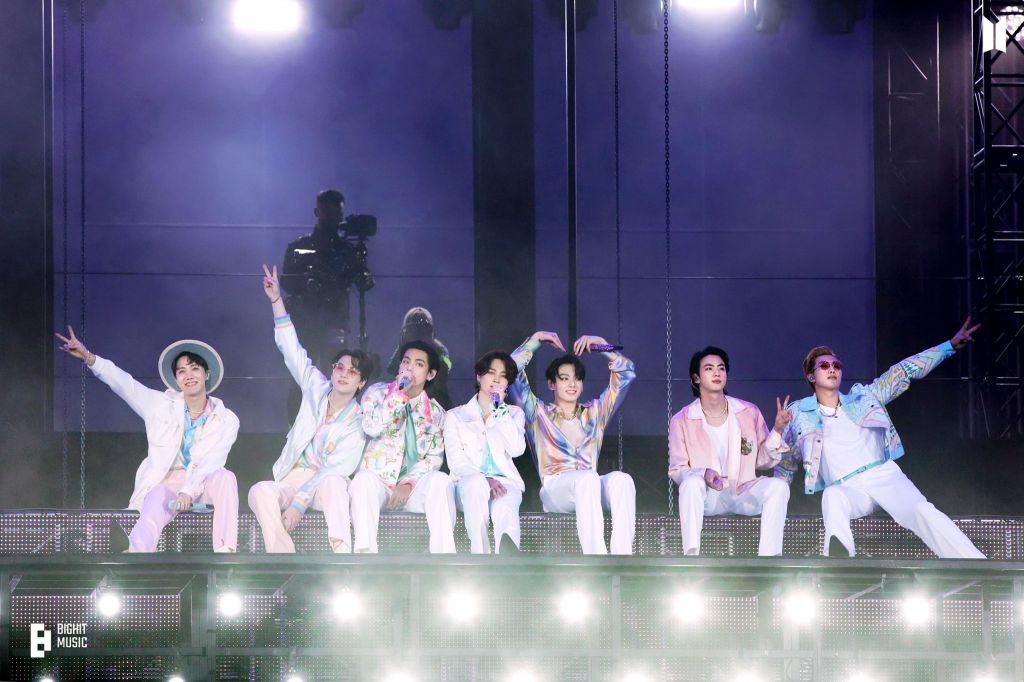
Nevertheless, seven men somehow gained the power to make me smile. Maybe because they had so much more content than AleXa or BLACKPINK, maybe just by chance, but either way, BTS became people I cared about, people who made me happy just by being happy. It’s the same kind of joy I feel when I see my friends laughing together or when I see my brother having fun with his teammates. A deep seated fondness.
I ran away from it when I first realized. It’s scary, the idea that people who are halfway across the world and completely unaware of your existence can affect you emotionally.
But I kept coming back to the fact that they made me happy.
Why should I hide from something that makes me happy and isn’t hurting anyone else? So, I listened to their music, watched their videos, and accepted them into my life. I let them make me happy and let them send their messages to me through music.
Their music isn’t necessarily deeper than other artists, nor is it inherently more meaningful. But because I spent the time looking at lyrics and translations, the messages in the music were more prominent in my mind. With English songs, it’s easy to memorize the words without actually thinking about them, but songs in another language require more attention. Once BTS started releasing songs in English, it was already a habit to read the lyrics and understand the message, so I did spend the time to think about what they were trying to say.
This doesn’t only apply to BTS, by the way. I use them as the example because they’re the first artist I connected to on a level deeper than ‘I like your music’, and because they’re still the artist I connect to the most, but plenty of other artists have a similar effect. Maybe the same phenomenon even happens to non-English speakers when listening to English music.
Aside from lyrics, Kpop astounds me with performances. The synchronization within groups and between artists and backup dancers is astounding, and the choreography is definitely not a walk in the park. I’ve learned a few Kpop dances, and as a non-dancer athlete, it was pretty hard. For me though, the most awe-inspiring aspect of Kpop performances is the staging.
The artists will almost always have a custom or personalized set during performances, whether they’re at large, year-end awards shows or weekly music broadcasts. The background, the outfits, and the concept are all carefully tied together to create exceptional performances. For example, here’s part of a year end performance at the MMAs from 2019 – it’s definitely worth watching.
Kpop performances actually inspired me to think about Entertainment Engineering as a possible track for my education. I think it would be insanely cool to help build the stages and sets that people’s favorite artists perform on. Both designing sets and actually bringing all the crazy ideas to life seem like challenging but rewarding work.
In Kpop, it’s never about just one aspect – of an idol, of a song, of a performance. It’s about both meaningful connections with fans and putting on spectacular performances.
 Sydney L. Merrill